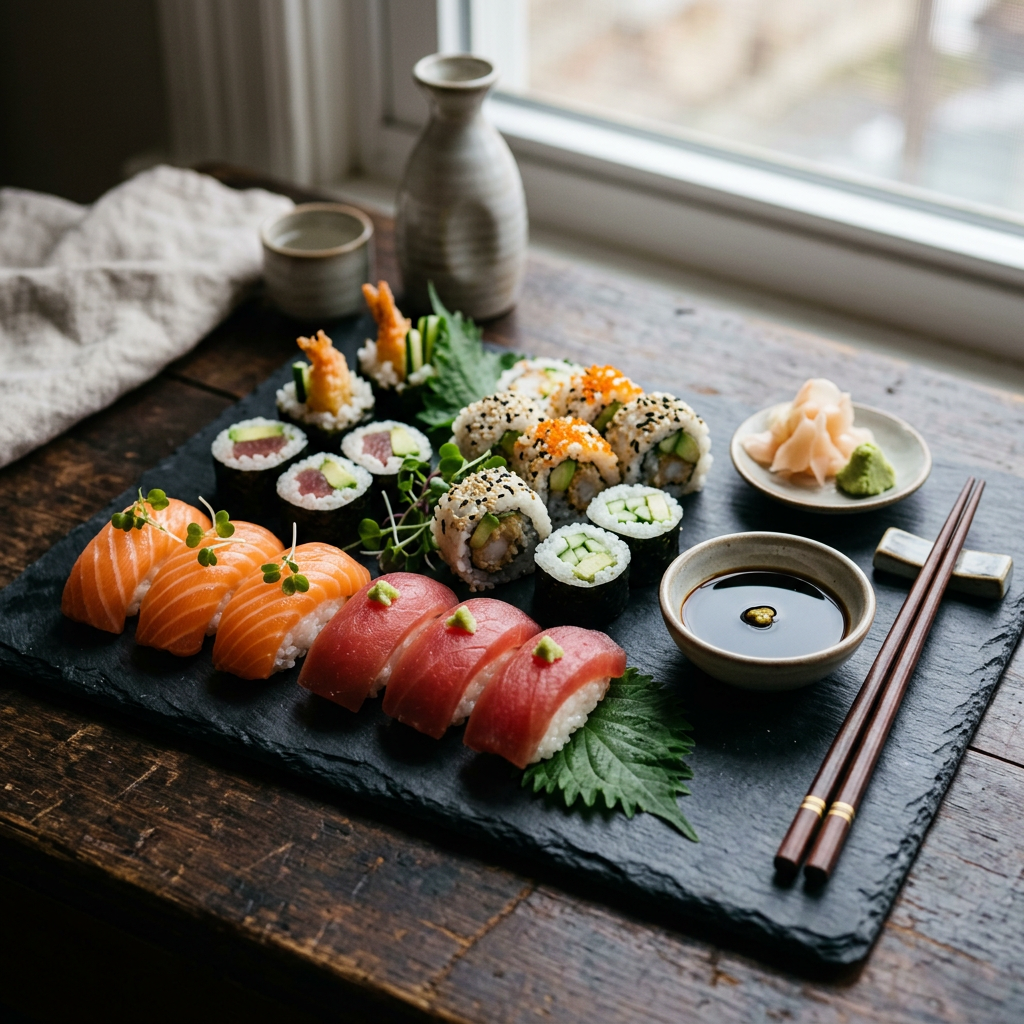
Short answer: Most sushi is halal or close to it — fish is broadly permissible, rice and nori are plant-based, and raw preparation means no cooking wine in the fish itself. The genuine questions are the seasonings: mirin (sweet rice wine) in sauces and some sushi rice, sake in marinades, unagi (eel) glaze, and imitation crab. A careful order at an ordinary sushi restaurant is achievable; a careless one can include alcohol-seasoned sauces without you knowing.
Sushi sits in an unusual position for halal diners. Unlike shawarma or pho, where the central question is meat slaughter, sushi's core ingredients are mostly permissible by default — seafood doesn't require zabiha slaughter in mainstream scholarship. (For rice-noodle bowls rather than rice rolls, our pho guide covers the halal Vietnamese soup and noodle menu question in depth.) The complications hide in the pantry. This guide goes shelf by shelf.
Is sushi halal?
Sushi is mostly halal by composition, with specific exceptions. Break a typical order into its parts:
- Fish (raw or cooked): halal in mainstream scholarship — fish does not require ritual slaughter.
- Sushi rice: rice, rice vinegar, sugar, salt — halal (see the vinegar note below).
- Nori, vegetables, avocado, sesame: plant-based, halal.
- Wasabi, pickled ginger: halal; some cheap pickled ginger uses trace flavourings worth a label check at grocery stores, but restaurant gari is low-concern.
- The exceptions: mirin- or sake-seasoned sauces, unagi glaze, some imitation crab, and certain specialty rolls.
So the question isn't really "is sushi halal?" — it's "which items on this particular menu involve alcohol-based seasoning or questionable additives?" That's a much more answerable question.
Is fish always halal?
The mainstream position across Sunni schools is that fish is halal and does not require ritual slaughter — a significant simplification compared to meat. Two nuances:
- Shellfish and non-fish seafood (shrimp, crab, octopus, squid) are considered halal by most scholars, but the Hanafi school traditionally permits only fish proper. Shrimp is widely accepted within Hanafi practice; crab, octopus and eel are where Hanafi diners often abstain. Know your own school's position before ordering the octopus nigiri.
- Eel (unagi) is a fish and thus halal as an animal in most views — but it is nearly always served glazed with a sauce made from mirin and sake, which is a separate problem covered below.
Does sushi rice contain alcohol?
Sushi rice is seasoned with rice vinegar, and vinegar is halal in mainstream scholarship — including vinegar produced from wine or sake, because complete transformation (the alcohol fully converting to acetic acid) is recognized as purifying by the overwhelming majority of scholars. Rice vinegar itself is not an intoxicant and cannot make you intoxicated in any quantity.
The caveat: some restaurants season their sushi rice with awasezu blends that include mirin for sweetness. This is a minority practice — sugar is the standard sweetener — but it's a fair question to ask: "Is your sushi rice seasoned with vinegar and sugar only, or does it contain mirin?"
Mirin and sake: the hidden alcohol question
This is the single most important section of this guide. Mirin is sweet rice wine (typically around 14% alcohol) and sake is rice wine — both are genuine alcoholic products, not trace-fermentation technicalities, and both are foundational to Japanese cooking. In a sushi restaurant they appear in:
- Unagi/eel sauce (nitsume or kabayaki glaze): classically mirin, sake, soy and sugar. Also drizzled on many "dragon" and other specialty rolls — not just eel items.
- Teriyaki sauce: same base. Relevant for teriyaki-topped rolls and cooked items.
- Spicy mayo and house sauces: usually mayo and chili sauce (fine), but recipes vary — some kitchens add mirin.
- Tamago (sweet egg omelette): traditional recipes include mirin or sake.
- Marinated fish preparations: some cooked or seared items are sake-marinated.
Whether cooked-off alcohol renders a dish permissible is debated, but the ingredient itself is unambiguously an intoxicating wine, and cooking does not remove all alcohol. The practical rule most halal diners adopt: skip glazed and sauced items unless the kitchen confirms no mirin or sake, and stick to plain nigiri, sashimi and simple rolls, where these sauces don't appear at all.
Is soy sauce halal?
Naturally brewed soy sauce contains a small amount of ethanol (commonly around 2%) produced during fermentation — similar in principle to the trace alcohol in ripe fruit or bread. The mainstream scholarly position treats fermentation by-product ethanol differently from added wine: soy sauce is not an intoxicating beverage, is not consumed for intoxication, and cannot intoxicate in any realistic quantity, so most authorities permit it. Diners following stricter opinions can look for chemically produced (non-brewed) soy sauce or halal-certified brands, several of which are stocked in Canadian groceries — our halal grocery guide covers label-reading in more depth.
Is imitation crab halal?
Imitation crab (surimi) — the pink-and-white stick in every California roll — is made from processed white fish, usually Alaskan pollock. The fish base is halal. The complications are the additives:
- Mirin or sake: some surimi recipes include rice wine as a flavouring. Halal-certified surimi brands exist and omit it.
- Crab flavouring: usually synthetic or fish-derived (fine), occasionally derived from real crab — which matters only for Hanafi diners avoiding crab.
- Stabilizers: occasionally include egg white or wheat; a halal concern only in rare formulations, an allergen concern otherwise.
Verdict: often halal, not reliably halal. A restaurant won't usually know its surimi supplier's full ingredient deck, so strict diners simply skip California rolls or ask whether the kitchen uses a halal-certified brand.
Other ingredients to watch
| Ingredient | Where it appears | Halal status |
|---|---|---|
| Unagi glaze / eel sauce | Eel items, dragon rolls, many specialty rolls | Avoid unless confirmed mirin/sake-free |
| Tamago (egg omelette) | Nigiri, rolls | Ask — traditional recipes use mirin |
| Ponzu sauce | Sashimi dressings | Ask — often contains mirin |
| Tempura items | Shrimp/vegetable tempura rolls | Low risk — batter is typically flour, egg, water; check for beer-batter variants and shared fryers |
| Tobiko/masago (fish roe) | Roll toppings | Mostly fine — roe is halal; some brands are mirin-seasoned |
| Cream cheese, mayo | Fusion rolls | Fine — dairy and egg-based |
Cross-contamination at the sushi counter
Sushi kitchens are actually favourable terrain here compared to grills: there's no pork on a classic sushi menu, and the raw items never touch cooking equipment. The realistic contact points are fewer:
- Shared knives and boards between glazed/marinated items and plain fish — low stakes since the "contaminant" is sauce, not pork, but relevant to strict standards.
- Shared fryers at restaurants that also serve a broader Japanese menu (chicken karaage marinated in sake, for example).
- Izakaya-style menus that include pork dishes (tonkatsu, chashu) alongside sushi — the one case where the pork question genuinely enters a Japanese kitchen.
Our general guide on avoiding cross-contamination applies; the summary for sushi is that a dedicated sushi bar is lower-risk than a full Japanese restaurant with a pork-inclusive menu.
The safest sushi orders
If you want to order confidently at an ordinary (non-halal-specialized) sushi restaurant, this is the low-risk list:
- Sashimi — plain sliced fish, nothing else. The safest item on the menu.
- Nigiri (salmon, tuna, whitefish) — fish on rice; skip eel and tamago.
- Simple maki: tuna roll, salmon roll, avocado roll, cucumber roll, salmon-avocado.
- Vegetable rolls and inari (sweet tofu pockets — ask about mirin in the simmering liquid if strict).
- Edamame, miso soup — check that the miso soup uses fish dashi (standard, fine) rather than anything sake-seasoned.
Items to skip or interrogate: anything glazed brown (eel sauce), teriyaki-topped rolls, tamago, ponzu-dressed dishes, California rolls if surimi sourcing is unknown, and — outside the food question entirely — remember that many sushi restaurants serve sake and beer, which affects diners who avoid alcohol-serving establishments altogether.
How to check a sushi restaurant
Adapted from the five-step check we use across this site:
- Ask about mirin and sake directly: "Do you use mirin or sake in your sushi rice, sauces, or any items I'd order?" This single question covers most of the risk.
- Ask about the eel sauce if you want specialty rolls — and whether it can be omitted.
- Check the wider menu for pork items (tonkatsu, chashu ramen) that signal a mixed kitchen.
- For surimi, either skip it or ask whether the brand is halal-certified.
- Prefer explicit claims: a restaurant that advertises halal-friendly practices has thought about these questions; our certified vs. friendly explainer covers what different claims actually mean.
In Ottawa, halal-conscious sushi options are tracked in our halal sushi guide — and if the verification hurdles feel like too much for tonight, an Asian-noodle alternative with verified halal-friendly sourcing already exists in the ByWard Market's Vietnamese kitchen. Every restaurant in our verified directory is labelled certified or halal-friendly with sources shown. As always — and per our editorial standards — verify directly with the restaurant if your requirements are strict, because kitchens and suppliers change.
The bottom line: sushi is one of the more halal-accessible cuisines once you know where the alcohol hides. Fish, rice, nori and vegetables are permissible territory; mirin, sake and glazes are the checkpoints. Ask two good questions and you can eat well almost anywhere.