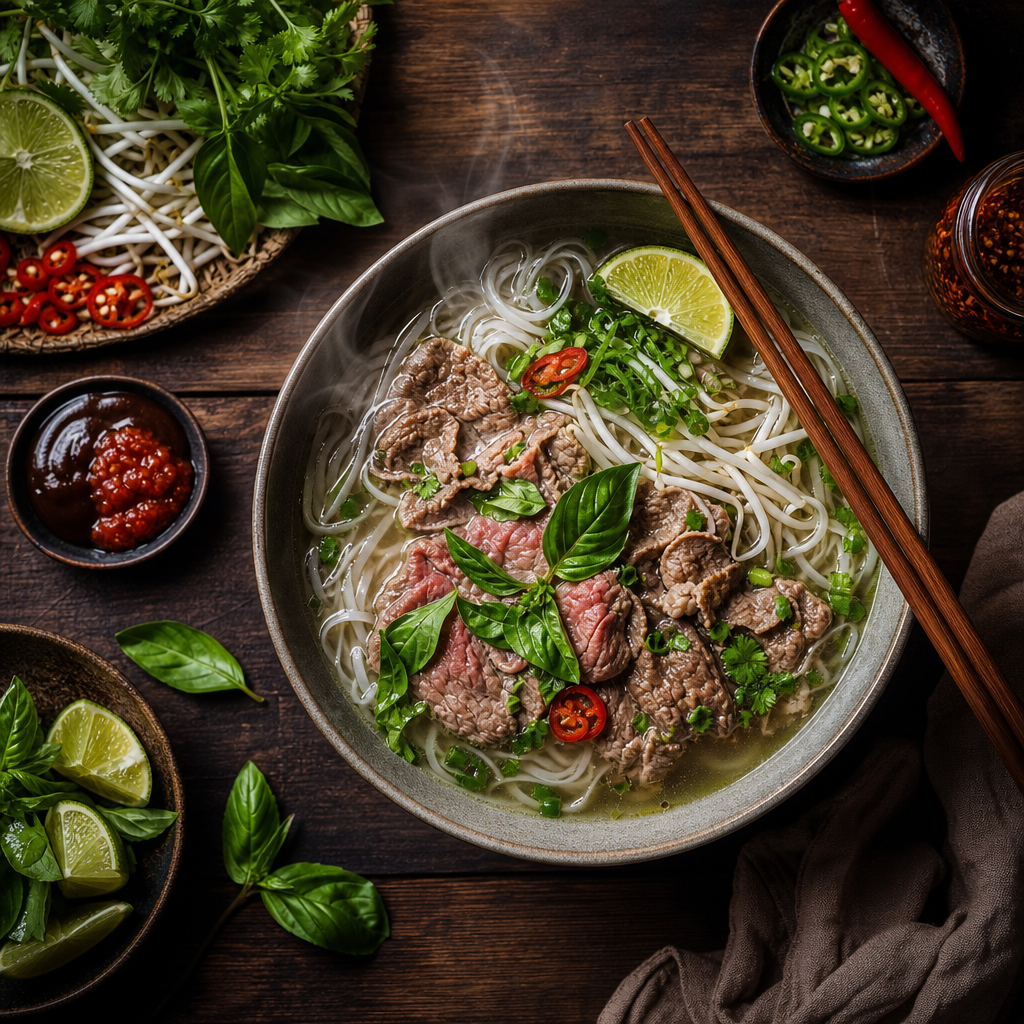
Short answer: Pho is halal only when it is made with halal-slaughtered meat, a broth simmered from halal bones with no pork products or added alcohol, and prepared without cross-contamination from non-halal items. Most Vietnamese restaurants do not meet these conditions by default, so Muslims should verify sourcing with the restaurant before ordering.
Pho — Vietnam's national noodle soup — is built from three things: rice noodles, a long-simmered meat broth, and sliced beef or chicken. None of those components is inherently haram, which is why halal pho is entirely possible and genuinely delicious. But because the dish revolves around meat and a communal stockpot, whether any specific bowl is halal depends entirely on the kitchen making it. This guide walks through every ingredient and preparation question, so you know exactly what to ask.
Is pho halal?
Pho is conditionally halal. The recipe itself contains nothing forbidden — beef or chicken, bones, rice noodles, charred onion and ginger, star anise, cinnamon, fish sauce, herbs. A bowl becomes halal or non-halal based on four factors:
- The meat: the beef or chicken must come from animals slaughtered according to Islamic requirements (zabiha).
- The broth: the bones simmered for the stock must also be halal-sourced, and the pot must be free of pork products.
- Added ingredients: no wine, cooking alcohol, or pork-derived additives in the broth or sauces.
- The kitchen: preparation without cross-contamination from non-halal proteins on shared equipment.
In practice, the majority of Vietnamese restaurants in North America are not halal — not because pho can't be, but because halal beef bones and zabiha meat are specialty supply chains most kitchens never set up. We covered why that scarcity exists, and where Ottawa diners can actually find a verified bowl, in our companion piece on halal pho in Ottawa.
What ingredients can make pho non-halal?
Here is every component of a typical bowl of pho and where the halal risk actually sits:
| Component | Typical ingredients | Halal risk |
|---|---|---|
| Meat topping | Sliced beef (rare steak, brisket, meatballs) or chicken | High — halal only if zabiha-slaughtered; beef meatballs may contain non-halal fillers |
| Broth | Beef or chicken bones, charred onion, ginger, spices | High — bones must be halal-sourced; one pot serves every bowl |
| Rice noodles (banh pho) | Rice flour, water | Low — plant-based and generally halal |
| Fish sauce (nuoc mam) | Fermented anchovies, salt | Low — most scholars consider it permissible (see below) |
| Garnishes | Thai basil, bean sprouts, lime, chili | None — all plant-based |
| Condiments | Hoisin sauce, sriracha | Low — check labels; mainstream brands are typically alcohol- and pork-free |
The pattern is clear: the risk is concentrated in the meat and the broth. Everything else in the bowl is plant-based or low-concern.
Is beef pho (pho bo) halal?
Beef pho is halal when both the sliced beef on top and the bones in the stockpot are zabiha-sourced. This double requirement is what trips up "halal option" claims: a restaurant can swap in halal steak slices, but if the broth underneath was simmered from conventional beef bones, the bowl is not halal. Because pho broth comes from a single pot that runs all day, a kitchen is effectively either all-halal on beef or not halal at all. Beef meatballs (bo vien) deserve extra scrutiny — they are often bought pre-made and can contain fillers or borax-era additives from non-halal supply chains.
Is chicken pho (pho ga) halal?
Chicken pho follows the same logic with one practical advantage: halal chicken is far easier to source in Canada than halal beef bones, so halal-friendly Vietnamese kitchens often find pho ga the easier dish to guarantee. The same broth rule applies, though — the chicken stock must be made from halal birds, and in some restaurants "chicken pho" is actually served in the house beef broth. Ask which stock the kitchen uses before assuming pho ga is the safer order.
Can pho broth contain pork?
Traditional pho broth does not contain pork — authentic pho bo is strictly beef and pho ga strictly chicken. However, pork appears around pho in three ways worth knowing:
- Some restaurants simmer a separate pork stock for other menu items (hu tieu, wonton soups) in the same kitchen, sometimes with shared ladles or strainers.
- A few kitchens add pork bones to their beef stock for sweetness — uncommon, but it happens.
- Side dishes like spring rolls, wontons and grilled-meat plates frequently contain pork even when the pho itself doesn't.
So while the classic recipe is pork-free, "does the pho have pork in it?" and "is this pho halal?" are different questions — a pork-free bowl made from non-zabiha beef still isn't halal.
Can pho contain alcohol?
Classic Vietnamese pho broth is not made with wine or cooking alcohol — its depth comes from charred onion and ginger, roasted bones, star anise, cinnamon, cloves and fish sauce. This makes pho different from many French and Chinese soup traditions where wine is standard. Two caveats: some fusion or non-traditional kitchens do splash rice wine into stocks, and trace ethanol from fermentation exists in condiments like hoisin. If alcohol is a strict concern for you, ask directly whether any wine or mirin-style seasoning is used in the broth.
On fish sauce: nuoc mam is fermented anchovy extract, not an alcoholic beverage. The mainstream scholarly position is that it is permissible, since any trace ethanol is a natural by-product of fermentation and not intoxicating in any consumable quantity. The same reasoning generally applies to soy sauce and hoisin, though naturally brewed soy sauces vary — diners who follow stricter opinions should ask how the broth is seasoned and check condiment labels for added wine or spirit vinegar processed with alcohol.
The condiment caddy on the table — hoisin, sriracha, chili oil, pickled garlic — is generally low-concern: mainstream brands of these sauces are plant-based and pork-free. If you carry a stricter standard on trace alcohol, the simplest move is to enjoy the broth as the kitchen built it, which is how pho purists recommend eating it anyway.
Are pho noodles halal?
Yes — banh pho noodles are made from rice flour and water, occasionally with tapioca starch for chew. They contain no animal products, no alcohol and no pork derivatives, making them halal by composition. The only realistic concern is preparation: noodles blanched in the same water or handled with the same utensils as non-halal items raise a cross-contamination question in mixed kitchens. In a genuinely halal-friendly restaurant, the noodles are the least of your worries.
Is banh mi halal?
Banh mi — the Vietnamese baguette sandwich — is usually not halal by default, and it's riskier than pho. The classic version is built on pork: cold cuts (cha lua), pork pâté, and mayonnaise on a French baguette. A halal banh mi requires a kitchen that replaces the pork entirely — typically with grilled lemongrass beef or chicken — and skips or substitutes the pâté. Halal-friendly Vietnamese restaurants do make excellent versions — in Ottawa, the lemongrass beef bánh mì on the menu of this halal-friendly Vietnamese kitchen in the ByWard Market is the benchmark — and our halal banh mi guide covers the verified options and what to look for on the menu.
What about cross-contamination in mixed kitchens?
Even when a restaurant offers genuinely halal-sourced meat, the kitchen environment matters. A "mixed" kitchen — one that serves both halal and non-halal items — introduces contact points that strict halal observance takes seriously:
- Shared stockpots and ladles. If a pork or non-halal beef stock simmers alongside the halal pot, shared ladles, strainers or skimming spoons move liquid between them.
- Shared grills and fryers. Lemongrass beef grilled on the same surface as pork sausage, or spring rolls fried in oil that has cooked pork-filled rolls, are the most common contact points in Vietnamese kitchens.
- Shared cutting boards and slicers. The deli slicer that portions cha lua for banh mi is a direct transfer point if it also slices halal beef.
- Blanching water. Noodle baskets dipped into a common blanching pot are low-risk in practice but worth asking about if your standard is strict.
How much this matters depends on your school of thought and personal standard. Some diners are comfortable once the meat itself is verified halal; others require dedicated equipment or a fully halal kitchen. The practical approach is to decide your own line first, then ask targeted questions: "Do you cook pork in this kitchen? Is the halal meat prepared with separate equipment?" A restaurant that takes its halal-friendly claim seriously will have thought about this and can answer specifically — vague answers are themselves a data point.
This is also exactly why our directory distinguishes tiers rather than giving a single yes/no. A fully certified restaurant has had these processes audited by a certification body; a halal-friendly one communicates halal sourcing but may operate a mixed kitchen. Both labels are documented with sources on every listing, following the process on our editorial standards page.
Which Vietnamese foods are commonly halal-friendly?
Once the kitchen's meat sourcing is verified halal, much of the Vietnamese menu opens up:
- Pho bo and pho ga — the flagship noodle soups.
- Bun (vermicelli bowls) — cold rice noodles with grilled halal beef or chicken, herbs and nuoc cham.
- Goi cuon (fresh spring rolls) — often shrimp- or chicken-based; seafood versions are broadly halal.
- Com ga / com bo (rice plates) — grilled meat over broken rice.
- Banh xeo (sizzling crepes) — typically shrimp and vegetables; confirm no pork.
- Che and Vietnamese coffee — desserts and drinks are generally halal (check for gelatin in jellied desserts).
Dishes to treat with caution anywhere: anything with cha lua (pork sausage), fried spring rolls (frequently pork-filled), wonton add-ons, and caramel-braised clay-pot dishes, which sometimes use pork or added wine. For the full picture of the cuisine through a halal lens, see our halal Vietnamese food guide and the dedicated halal pho guide.
How can you tell if a Vietnamese restaurant serves halal pho?
A practical five-step check, in the order we use it ourselves:
- Look for an explicit halal claim. A serious halal-friendly kitchen says so — on the menu, the storefront, or its website. Silence usually means no.
- Ask about the meat supplier. "Is your beef and chicken zabiha halal, and who supplies it?" A kitchen that genuinely sources halal can answer immediately.
- Ask about the broth specifically. Halal slices over non-halal broth is the most common gap. Confirm the bones in the stockpot are halal too.
- Scan the menu for pork. A menu full of cha lua and pork pâté means shared equipment at minimum; ask how the kitchen separates preparation.
- Distinguish certified from halal-friendly. Certification means a recognized body has audited the restaurant and current documentation exists; halal-friendly means the restaurant communicates halal sourcing without site-level certification. We explain how we apply these tiers on our certified and halal-friendly collections — and always verify directly with the restaurant or the certification body if your requirements are strict.
In Ottawa, the anchor of the halal Vietnamese scene is Pho By Night in the ByWard Market — our directory listing has the address, hours and the sources behind its halal-friendly status, and our short answer page covers the question directly: is Pho By Night halal? You can also browse the restaurant's menu of halal-friendly pho and vermicelli bowls straight from the source. The Vietnamese in ByWard Market page tracks the category as the directory grows.
The bottom line: pho has no structural conflict with halal eating — it's a rice-noodle soup built on beef, chicken and aromatics. The entire question comes down to sourcing and the stockpot. Verify those two things and you can eat one of the world's great soups with complete confidence.