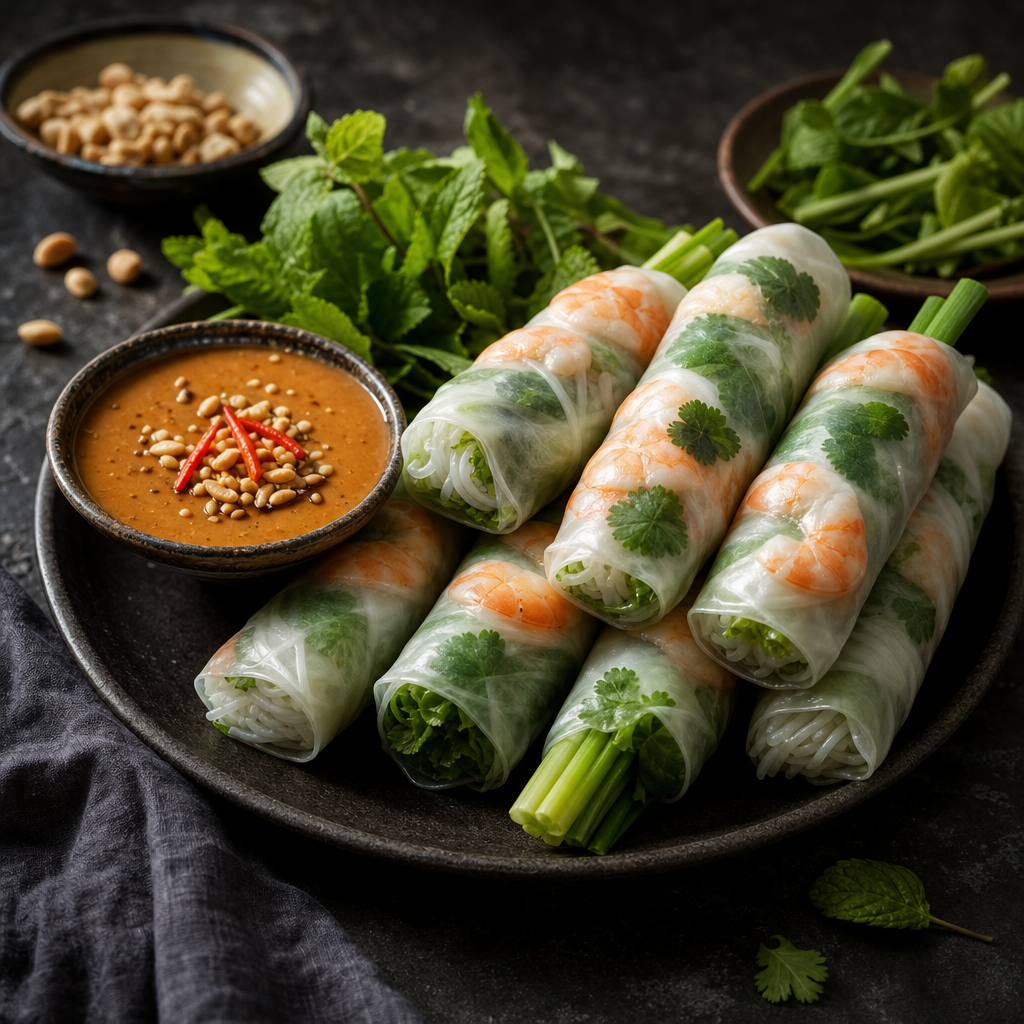
Short answer: It depends entirely on which spring roll. Fresh Vietnamese rolls (gỏi cuốn) are typically shrimp, herbs, vermicelli and lettuce in rice paper — broadly halal-friendly, though some versions add pork. Fried spring rolls (chả giò) are a genuine risk: pork is the traditional filling, and at conventional restaurants they also share fryer oil with other pork items. Always ask what's inside.
"Spring roll" is one of the most ambiguous words on any Asian menu. Under that one English name live two Vietnamese dishes with opposite risk profiles — plus Chinese, Thai and fusion cousins that muddy things further. For halal diners, learning to tell them apart is one of the highest-value skills in the cuisine.
Are spring rolls halal?
There is no single answer, because there is no single spring roll. The useful question is: fresh or fried, and what's the filling?
| Roll | Typical filling | Halal risk |
|---|---|---|
| Fresh rolls (gỏi cuốn) | Shrimp, vermicelli, lettuce, mint — sometimes with sliced pork | Low–moderate — shrimp versions are broadly permissible; confirm no pork slice inside |
| Fried rolls (chả giò) | Traditionally ground pork with wood-ear mushroom and glass noodles | High — pork is the default filling at conventional restaurants |
| Chicken/beef/vegetable rolls | Halal-friendly kitchens' versions | Low — when the kitchen's sourcing is verified |
| Chinese-style egg rolls | Often pork and cabbage in wheat wrappers | High — same pork default |
Fresh rolls (gỏi cuốn): the lower-risk order
Gỏi cuốn — "salad rolls" — are uncooked: rice paper wrapped around poached shrimp, rice vermicelli, lettuce and mint. Seafood doesn't require ritual slaughter in mainstream scholarship, so a shrimp-only roll is permissible territory by default. The single caveat: the traditional Vietnamese version pairs shrimp with thin slices of boiled pork in the same roll. Many restaurants in Canada make them shrimp-only; some don't. One question — "are the fresh rolls shrimp only, or shrimp and pork?" — settles it.
Fried rolls (chả giò): the hidden-pork problem
Fried spring rolls are a different story, and they're the item we most often see halal diners order without realizing the risk. Three problems stack up at a conventional restaurant:
- The filling is pork by default. Classic chả giò is seasoned ground pork with glass noodles, carrot and wood-ear mushroom. The filling is sealed inside an opaque fried wrapper — you cannot see what you're eating.
- The fryer is shared. Even a chicken or vegetable roll goes into oil that has fried pork rolls all day.
- Menus under-describe them. "Spring rolls (2)" tells you nothing. English menus frequently drop the filling entirely.
At a verified halal-friendly kitchen, all three problems disappear at once: the filling is halal protein or vegetable, and there's no pork in the fryer because there's no pork in the building. This is the same structural logic we describe across the cuisine in our halal Vietnamese guide — the kitchen's overall sourcing answers a dozen per-dish questions simultaneously.
Are the wrappers halal?
Yes, both kinds. Rice paper (bánh tráng) is rice flour, tapioca starch, salt and water — halal by composition. Fried-roll wrappers are either the same rice paper or a wheat-flour wrapper; neither traditionally contains lard or alcohol. The wrapper is never the problem; the filling and the fryer are.
Are the dipping sauces halal?
Fresh rolls come with peanut-hoisin sauce (permissible — hoisin is plant-based; mainstream brands carry only incidental fermentation traces) or nuoc cham, the fish-sauce-lime dip. Mainstream scholarship considers fish sauce halal — it's a fermented fish product, not an intoxicant; our fish sauce explainer covers the reasoning. Fried rolls are also served with nuoc cham. Neither sauce is a realistic concern for most halal diners.
How to order spring rolls with confidence
The reliable path is the same one we recommend for pho and every other Vietnamese dish: start from a kitchen whose sourcing is already verified. In Ottawa, that's the ByWard Market's halal-friendly Vietnamese restaurant — the fresh rolls and appetizers on the halal-friendly Vietnamese appetizer menu come from a kitchen whose halal-friendly status, sources and hours are documented in our directory listing.
Elsewhere, ask two questions: "What's inside the rolls?" and "Is the fryer shared with pork items?" A kitchen that takes halal seriously answers both instantly. And if you're building a full meal around the appetizers, the natural next orders are a vermicelli bowl or a bowl from the ByWard Market's halal-friendly pho menu — the rest of that decision tree lives in our halal pho in Ottawa article and the halal-friendly collection. Per our editorial standards: verify directly with any restaurant if your requirements are strict.